

With the improvement of people's living standards and the change of consumption concept, while the proportion of fresh meat in the whole meat industry is increasing, consumers have higher and higher requirements for the quality and hygiene of fresh meat.
The color of fresh meat is one of the signs to evaluate the quality change of fresh meat, and it is also the main factor to attract consumers' desire to buy; the degree of binding between myoglobin and oxygen in fresh meat determines its color change. Freshly slaughtered meat contains a large amount of myoglobin, which is purple in color. When it is placed in the air for a period of time, the purple-red myoglobin combines with oxygen to form oxymyoglobin, and the color is bright red at this time. Oxidized myoglobin is formed when myoglobin or oxymyoglobin is strongly oxidized, and when its amount exceeds 50% or more, the meat turns brown.
For gradually discolored meat causes, it boils down to the following:
1. Oxygen partial pressure
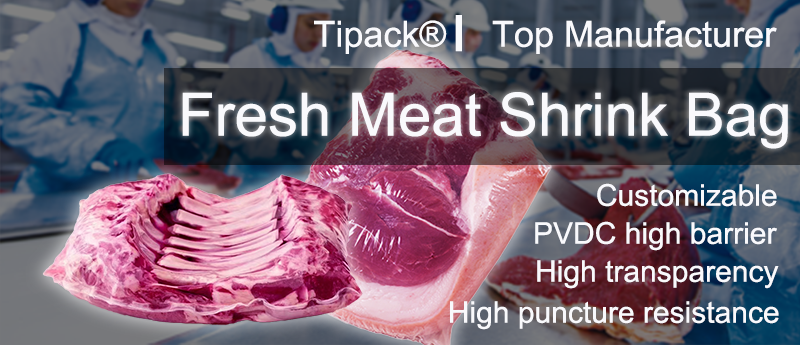
The surface layer of meat is mainly composed of oxymyoglobin, which is bright red; the middle layer is mainly methemoglobin, which is brown; the lower layer is mainly reduced myoglobin, which is purple. This is due to the gradual decrease in oxygen partial pressure during the deep penetration of oxygen into the muscle. Under low oxygen partial pressure, oxymyoglobin is converted into myoglobin and further into oxymyoglobin. Under anaerobic conditions, meat can effectively prevent browning and oxidation. TipackGroup multi-layer co-extruded high-barrier Shrink Bag perfectly prevents the contact between fresh meat and oxygen, which can effectively extend the freshness period of meat and maintain its delicious taste.2. Temperature
High storage temperature will promote the oxidation of myoglobin, accelerate the growth of microorganisms, enhance the activity of respiratory enzymes, and rapidly oxidize fat, and reduce the shelf life of meat. Therefore, fresh meat should be stored at the lowest possible temperature. Shrink Film and Shrink Bag of the TipackGroup brand greatly reduce the temperature requirements for fresh meat preservation, making it easier to keep fresh.3. Light
Light energy can promote the formation of methemoglobin in the preservation of fresh meat and accelerate the auto-oxidation of fat. Therefore, packaging materials for fresh meat should absorb as much UV light as possible.4. Microorganisms
The growth of microorganisms consumes a lot of oxygen, which reduces the oxygen partial pressure on the meat surface and promotes the formation of high iron myoglobin; some microorganisms produce some by-products, the most common ones are hydrogen sulfide and hydrogen peroxide, which are associated with unstable myoglobin. Produces thiohemoglobin, cholglobin, etc., which discolors the meat. In some cases, the color of meat can sometimes turn green, yellow, bluish and fluorescent due to bacteria, molds multiplying on the surface of the meat or breaking down proteins. Therefore, in order to prolong the shelf life, fresh meat needs to strictly control the sanitary conditions from slaughtering to processing. It is best to start low-temperature storage when the number of microorganisms is low to control the initial number of contaminating microorganisms.Deterioration and spoilage caused by microorganisms
There are very few microorganisms in the meat just after slaughter. However, the microorganisms that invade the body with blood and lymph during the slaughtering process will multiply rapidly over time. These microorganisms first contaminate the surface of the meat, and then spread to the deep layers along the connective tissue. The collagenase secreted by the microorganisms hydrolyzes the collagen of the connective tissue to form mucus, and at the same time generates gas and decomposes it into amino acids, water, carbon dioxide and ammonia. If glycogen is present, it will also ferment to form acetic acid and lactic acid, so it often has a foul smell.
Microbes perform two enzymatic reactions to fat in meat: one is the breakdown of fat by secreted lipases to produce free fatty acids and glycerol; the other is oxidase oxidation of fat, resulting in an oxidized rancid odor.
Contamination such as dry consumption and dust
In the process of freezing or refrigeration, due to the continuous evaporation of water on the surface of the meat, the weight of fresh meat continues to decrease, that is, dry consumption occurs. If the exchange of moisture and heat between the meat and the air is reduced, the dry consumption will be greatly reduced.If the meat is transported and stored in the naked form, the meat will be in direct contact with the transportation tools, storage places and air. The dirt and odor in these environments will often contaminate the meat itself and cause the loss of the meat. The basic principle of fresh meat packaging.
The color of fresh meat is the result of the action of myoglobin and oxygen, so the air permeability of the packaging material must ensure the best combination of fresh meat and oxygen to ensure the best color of fresh meat. From this point of view, packaging materials are generally required to have high air permeability. On the other hand, if the air permeability of the packaging material is high, the oxygen content in the packaging is large, the aerobic microorganisms multiply rapidly, and the oxidation of fat in the meat is also fast. Therefore, the effect of preservation and bacteriostasis is generally achieved by a combination of packaging and refrigeration.
In order to prevent excessive loss of moisture in the meat, the relative humidity of the storage and transportation environment should be maintained at 85% to 95%, which requires the use of packaging materials with low moisture permeability to prevent gas exchange between the inside and outside of the package and loss of moisture.
Forms and materials of fresh meat packaging
Guaranteeing the edible quality and appearance color of the meat is the main purpose of the packaging.1. Inflatable packaging
The effect of gas ratio on the shelf life of fresh meat [4, 5] is different from other packaging in that the inflatable packaging of meat does not replace all the oxygen in the packaging with other gases, but ensures that there is an appropriate amount of oxygen in the packaging. When the oxygen content in the package reaches 75% and the carbon dioxide content reaches 25%, the shelf life of fresh meat is the longest, about 120 to 144 days; in addition, if the mixed gas is 40% O2, 3 0% CO 2 and 3 0% N 2 can also achieve a good effect of modified atmosphere preservation [6], while other various packagings are not as good as air-filled packaging in terms of sensory indicators, physical and chemical indicators and bacteriological quality inspection.When the meat is air-packed, the film with low air permeability and moisture permeability can be used to make the packaging bag, and the fresh meat is packed into the bag with pulp molded tray or foamed PS tray liner. Then fill a certain proportion of oxygen, carbon dioxide and nitrogen and seal. Since PVDC has extremely low air permeability and moisture permeability, and has been mass-produced and put into use in my country, fresh meat can be packaged with PVDC Shrink Film. At present, a large number of foreign countries use PVDC / PE composite film for packaging.
The air-filled packaging of fresh meat can also be in the form of semi-rigid containers such as blister trays. At present, some foreign countries use 300-800 μm thick composite plastic sheet EVC/EVA, PVC/EVOH/EVA or PS/EVOH/PE to blister into the shape of a shallow plate. After filling with fresh meat and gas, use PET/PE or multi-layer co-extruded PVC/PVDC/EVA composite film coated with PVDC [thickness 70-100 μm] is used as a covering and sealing material. Since the composite materials coated with PVDC or co-extruded with PS/EVOH/EVA in my country have not yet entered the production and application stage, and the air permeability of other materials is particularly high, the inflatable packaging of fresh meat in the form of shallow trays will take a period of time to develop in China. into the practical stage.
In European and American countries, fresh meat products that are conveniently packaged in supermarkets are basically mixed with gas inflatable packaging. After the fresh meat is loaded into the PP MAP Tray, it is filled with mixed gas (70% to 80% of oxygen, 30% to 20% of carbon dioxide), and then tightly heat-sealed with polyvinyl chloride film with high gas resistance and anti-fog. At present, this method has also begun to be applied in our country.
2, vacuum packaging
Vacuum packaging allows meat to be stored for a considerable period of time by removing the oxygen that makes fatty acids and microbes survive. But traditional vacuum packaging technology is not entirely suitable for packaging fresh meat. Because fresh meat is basically in an anaerobic environment when vacuum packaging fresh meat, the color of fresh meat will become light red or white, which is not conducive to the sales of fresh meat. The traditional vacuum packaging method is generally suitable for units or departments that have a large demand for fresh meat such as restaurants and do not pay attention to the color of fresh meat. If the color of the vacuum packaging becomes better while ensuring the storage effect of the vacuum packaging, the vacuum packaging is very suitable for sales packaging. Accordingly, it can be considered to change the air permeability of vacuum packaging in different circulation stages, that is, to maintain a low air permeability during storage, to ensure that fresh meat is not spoiled due to excessive oxygen and the proliferation of microorganisms; The air permeability makes the fresh meat quickly react with oxygen to generate oxymyoglobin, and the fresh meat appears bright red, which promotes sales.In the case of vacuum packaging with film. The fresh meat is placed on a paper tray with strong water absorption to prevent the gravy from seeping out, and then wrapped or bagged with film 1 with high air permeability, and then set with film 2 with good gas barrier properties. And vacuum, seal. After packaging in this way, since the fresh meat is stored in a vacuum environment, corruption will not occur in a long storage period, and the fresh meat is light red or pink at this time. When the fresh meat is sold at the counter, the salesman will open the outer film 2, at this time, the outside oxygen will quickly pass through the film 1 to react with the fresh meat, and the fresh meat will turn bright red after absorbing oxygen, thereby promoting the freshness of the meat. Sale of meat.
It is the case of vacuum-packing fresh meat in a blister box. The film 1 is a material with high air permeability, the film 2 is a material with low air permeability, and the blister box itself also has a low air permeability. The mechanism of action of this package is the same as in Figure 1.
In the above packaging methods, LDPE can be used for film 1, PVDC single-layer film or PVDC/PE composite film for film 2, and PVC/EVA sheets for blister packaging. If the fresh meat after peeling off the PVDC film cannot be sold in a short time, the seller can repackage it with PVDC film to prolong the storage period.
It should be pointed out that whether it is vacuum packaging or air-filled packaging, it must be combined with other methods of inhibiting microorganisms to prevent the spoilage of fresh meat to the greatest extent. These methods mainly include the reduction of water activity, the use of additives, low temperature storage and organic acid treatment, and their essence is to make microorganisms lack growth conditions and cannot grow and reproduce.


