

Environmental change
Swine fever outbreaks in Africa
In the first two months of 2022, a total of about 30 cases occurred in Africa, while more than 10,000 pigs were infected and culled in Russia and Romania.COVID-19
●Affected by COVID-19, people pay more attention to food hygiene and safety, and countries around the world and consumers themselves have higher requirements for food safety●People who are asked to go out less often turn to supermarkets and e-commerce platforms to buy pork
●COVID-19 has seriously affected the resumption of work and production in various countries and regions around the world, making resources such as grain and pork increasingly tight.
National Reserve Meat
National meat reserves are meat products reserved by the state in response to major natural disasters, public health incidents, animal epidemics or other emergencies that cause abnormal market fluctuations and market regulation, including reserved live animals (including live pigs, live cattle, live animals, etc.). sheep,) and reserve frozen meat (including frozen pork, frozen beef, frozen lamb,).The national reserve meat usually stores pork in an environment of minus 18 ℃, and the shelf life of stored pork is 6 months. In principle, frozen pork is reserved for 3 rounds per year, and the rotation is completed every 4 months.
The problem we are facing
Health and Safety
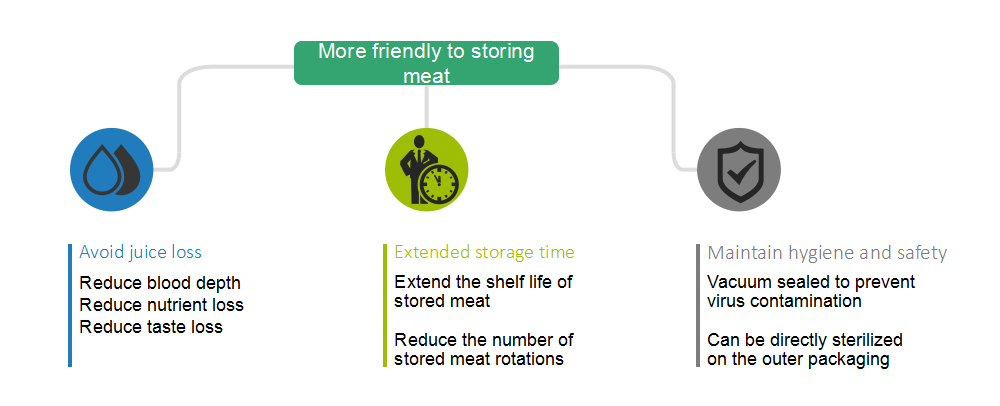
National meat reserves must ensure the safety of edible meat, including not suffering from COVID-19 infection and so on.Short reserve time
The preservation of fresh meat is naturally time-sensitive. Even in a low temperature environment of minus 18 degrees Celsius, frozen meat is required to be stored for a maximum of 6 months for safety.nutrient loss
Frozen meat will gradually lose water during storage, and the nutrients in it will also be lost along with the water.
Decreased taste
The freezing process destroys the cells, making them incapable of metabolizing, which in turn affects the taste of the meatSolution
●For fresh meat storage, it is necessary to control the number of microorganisms from the beginning of the production process, choose tight packaging to prevent blood and water from flowing out and accelerate the reproduction of microorganisms, and control the temperature and humidity of the storage room.●Use PVDC and EVOH high-barrier packaging films, packaging bags. The PVDC heat shrinkable packaging is tighter, forming a "second skin", which can not only make the product have a more competitive appearance, but also greatly extend the shelf life of the meat, reduce the loss of the product, and facilitate transportation to reduce transportation costs.
●Benefits of PVDC high-barrier shrink bags for fresh meat packaging - storage of meat products:
About Tipack Group
Headquartered in Suzhou, only 20 kilometers away from Shanghai, Tipack Group is the first-class overall solution provider of fresh meat packaging in China.Tipack is one of the participants and drafters of China's fresh meat packaging industry standards.
Tipack has more than 100,000 square meters of factories, independent R&D and testing teams, and 14+years of global supply experience.
Tipack supplies one-stop products and services including Shrink Film, Shrink Bag, Vacuum Bag, MAP Trays, VSP Trays, Fruit Cup, Lidding Film, Packaging Machine and many more.


